Mar 13th 2026
CS-003: Aerospace Class A Qualification — SunTiger Industries AWS D17.1/D17.1M:2024 TIG Certification
Arc-Zone® Case Study
Jim Watson (AKA Joe Welder)
CEO & Founder, Arc-Zone.com
Product Innovator | Director of Manufacturing | U.S. Patent Holder
Technical Author | Trade Publication Contributor | eCommerce Pioneer
Arc-Zone® | Technical Leadership. Proven Shop-Floor Results
Executive Summary
SunTiger Industries initiated qualification to AWS D17.1/D17.1M:2024 Class A — the highest weld integrity classification within the aerospace fusion welding specification. Class A welds apply to structural and flight-critical components where discontinuity tolerance is minimal and mechanical performance must closely approach base material properties.
Arc-Zone supported this effort through standards-aligned equipment access, traceable consumables, and procedural discipline consistent with aerospace documentation environments.
Qualification Scope
- Process: TIG (Gas Tungsten Arc Welding / GTAW)
- Base Material 1: Aluminum 6061, 0.035–0.125 inch thickness
- Filler 1: ER4043, 0.047–0.062 inch diameter
- Base Material 2: Stainless Steel 347, 0.035–0.125 inch thickness
- Filler 2: ER347, 0.035 inch diameter
- Test Coupons: 6 x 8 inch sheet metal (butt groove and fillet joints)
- Inspection Methods: Liquid Penetrant (PT), Radiographic (RT/X-ray), Destructive Testing
- Inspection Authority: Certified Welding Inspector (CWI)
- Consumable Requirement: Flagged filler rod with certification and heat lot traceability
- Additional Procurement: Aerospace-appropriate tungsten specified and quoted
- Target Timeline: Qualification approval following iterative refinement
Industry Context — What AWS D17.1 Class A Represents
AWS D17.1/D17.1M:2024 governs fusion welding of aircraft and space flight hardware. The standard defines welding procedure qualification requirements, welder performance qualification criteria, inspection methods, acceptance limits, repair rules, and documentation retention.
Class A is the most stringent tier within the specification and is typically required for:
- Primary structural members
- Load-bearing brackets and frames
- Pressure boundary components
- Hardware subjected to cyclic fatigue or vibration
Acceptance limits significantly restrict porosity cluster size and density, linear indications, lack of fusion, cracks (zero tolerance), and inclusions.
In aerospace environments aligned with AS9100 and Nadcap expectations, Class A qualification demonstrates not only welding capability, but mature process control.
Why TIG (GTAW) Was Selected
Gas Tungsten Arc Welding (GTAW) was selected due to precise heat input control, stable arc characteristics, controlled filler addition, and suitability for thin-gauge material.
At thicknesses between 0.035 and 0.125 inch, heat control becomes critical. Excessive heat may distort thin sections, increase grain growth, degrade the Heat Affected Zone (HAZ), and reduce mechanical properties.
Metallurgical Rationale — 6061 Aluminum with ER4043
6061 aluminum is precipitation-hardened. During welding, localized heat dissolves strengthening particles in the HAZ. Poor heat control can reduce yield strength.
ER4043 filler contains approximately 5% silicon. Silicon improves weld pool fluidity and reduces hot cracking susceptibility by narrowing the solidification temperature range and lowering shrinkage stress.
This combination supports controlled cooling and reduced crack risk in thin-gauge 6061 sheet.
Metallurgical Rationale — 347 Stainless with ER347
347 stainless steel is stabilized with niobium. During welding, chromium can combine with carbon at grain boundaries, forming chromium carbides and reducing corrosion resistance.
Niobium preferentially binds with carbon, preventing chromium depletion. ER347 filler mirrors this chemistry, preserving corrosion resistance and structural stability under thermal cycling.
Qualification Structure — WPS, PQR, WPQ
The Welding Procedure Specification (WPS) defines essential variables such as amperage range, polarity (DCEN), shielding gas composition, travel speed, filler classification, interpass temperature, and joint design.
The Procedure Qualification Record (PQR) documents the actual test weld performed under WPS parameters and validates results through PT, RT, and destructive testing.
Welder Performance Qualification (WPQ) verifies consistent reproducibility.
Inspection Rigor — Class A Acceptance
Liquid Penetrant Testing (PT) identifies surface-breaking cracks and linear indications. Radiographic Testing (RT) evaluates internal discontinuities such as porosity, lack of fusion, inclusions, and linear indications.
Destructive bend testing verifies ductility and root penetration integrity. Failure outside allowable limits results in qualification rejection.
Equipment and Consumable Discipline
Clean Room, High Purity TIG Equipment, Gas Scrubber Console & Related Disciplines
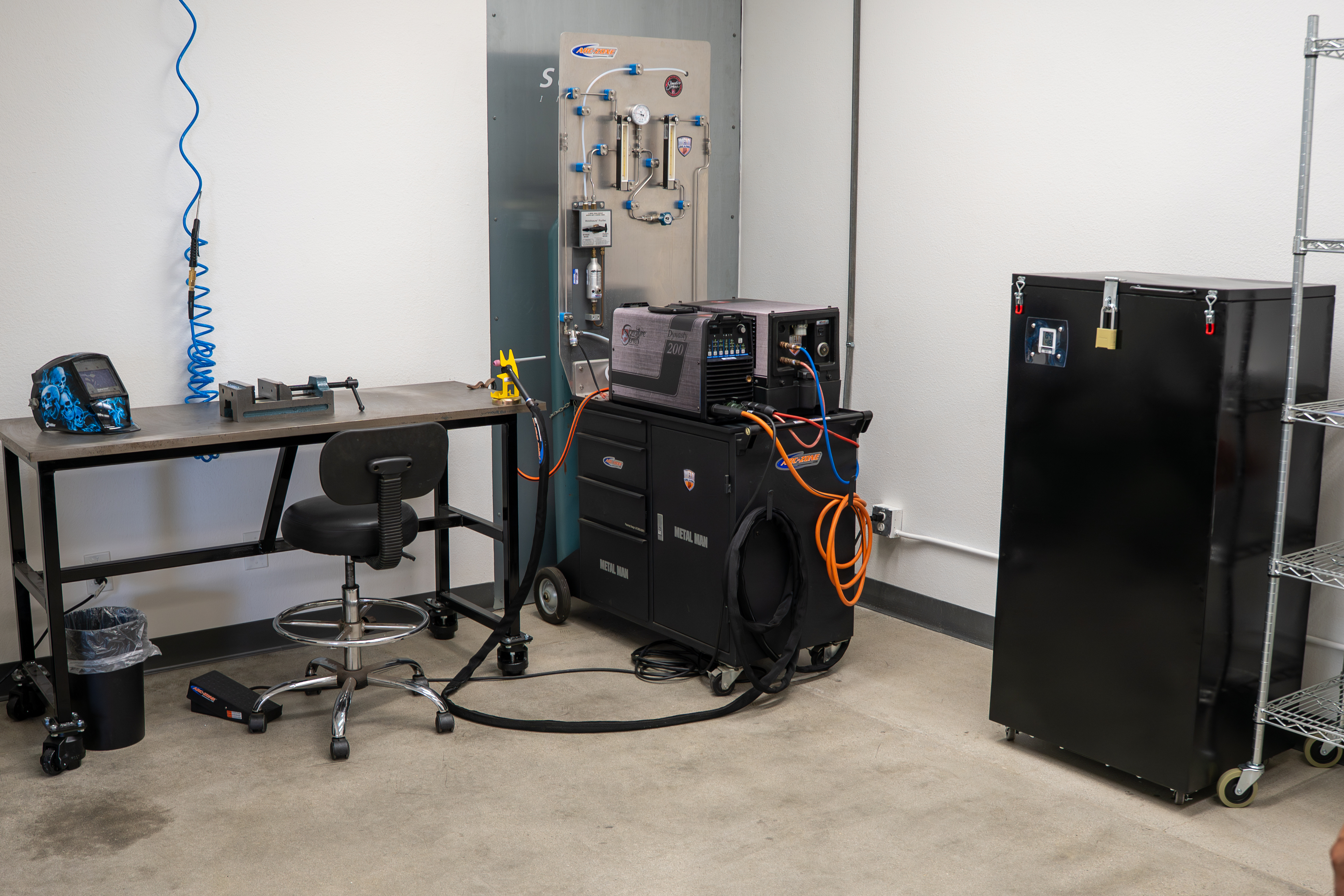
Qualification required stable high-frequency arc start, precise low-amperage control, water-cooled torch systems, laminar gas lens shielding, and high-purity argon.
Arc-Zone Supplied:
- JW Signature Series TIG torch kit with non-permeable gas hose and one way check valve
- Precision diamond ground Hybrid tungsten electrode
- Engineered shield cup and gas flow straightener.
- Upgraded TIG machine with high-purity solenoid kit
- High purity gas scrubber console
- Stainless steel gas connections with high density non permeable supply lines
- Flagged filler rod with certification and heat lot traceability. Heat lot traceability ties consumables to mill test reports, supporting aerospace documentation standards.
Strategic Impact
This case demonstrates alignment between standards compliance, metallurgical understanding, equipment discipline, inspection rigor, consumable traceability, and documentation structure.
Arc-Zone’s involvement positioned it as a technical enabler within the aerospace welding qualification pathway.
Conclusion
SunTiger Industries’ pursuit of AWS D17.1 Class A certification represents a disciplined transition toward aerospace manufacturing readiness.
CS-003 reflects the process integrity, documentation control, and metallurgical discipline required for aerospace participation.


