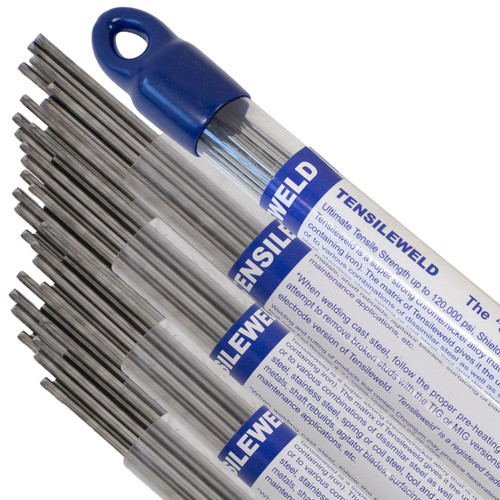


Tensileweld High-Strength Welding Rod – 36" Long, 1 lb Mini Pack (Select Size From Options Above)
High-strength, crack-resistant welding alloy for dissimilar steels, tool steels, high-carbon steels, and difficult-to-identify base metals.
Washington Alloy Tensileweld is a chromium-nickel high-strength welding alloy designed for demanding repair, joining, and build-up applications. Its unique austenitic-ferritic weld structure produces a dense, tough, crack-resistant deposit with excellent strength and ductility.
Tensileweld is especially useful when welding dissimilar steels or when the exact alloy of the base metal is unknown. It can be used on high-carbon steel, tool and die steels, stainless steel, spring steel, cast steel, manganese steel, clad steel, and other difficult-to-weld materials.
Package Information: This Arc-Zone listing is sold in 1 lb Mini Packs. Each rod is 36" long and is available in 1/16", 3/32", or 1/8" diameter.
Available Sizes
| Arc-Zone Part # | Rod Diameter | Rod Length | Package |
|---|---|---|---|
| WA-TENSILEWELD-116 | 1/16" | 36" | 1 lb Mini Pack |
| WA-TENSILEWELD-332 | 3/32" | 36" | 1 lb Mini Pack |
| WA-TENSILEWELD-125 | 1/8" | 36" | 1 lb Mini Pack |
Why Choose Tensileweld?
- High-Strength Weld Deposit: Designed for demanding repair and joining applications.
- Excellent Crack Resistance: Austenitic-ferritic weld structure helps produce tough, crack-resistant deposits.
- Dissimilar-Metal Welding: Especially useful when joining different steel alloys.
- Unknown Base Metals: A practical choice when the exact alloy content of the steel is not known.
- Heat, Corrosion & Abrasion Resistance: Weld deposits provide resistance to demanding service conditions.
- Impact Resistant: Useful for components exposed to shock or impact.
- Machinable Deposit: Finished weld metal can be machined when required.
- 36" Straight Rods: Long cut-length rods are convenient for controlled filler-metal applications.
Common Base Metals & Applications
Washington Alloy identifies Tensileweld for use with a broad range of difficult-to-weld metals, including:
- Dissimilar steels
- High-carbon steels
- Tool steels
- Die steels
- Stainless steels
- Spring and coil steels
- Manganese steel
- Cast steels
- Clad steels
- Unknown steel grades
Typical Repair Applications
- Steel castings
- Forgings
- Gears
- Tools and dies
- Shear blades
- Shaft rebuilding
- Agitator blades
- Turbine components
- Cast steel parts
- Structural repairs to tools and dies
- Buffer or underlay layers before hardfacing
Ideal for Dissimilar & Unknown Steels
One of the biggest advantages of Tensileweld is its ability to handle applications where the base metals are different or the exact material grade is unknown.
Its chromium-nickel composition creates a unique austenitic-ferritic structure with fine-grained delta ferrite in a rich austenitic matrix. This helps produce a strong, ductile, and highly crack-resistant weld deposit.
Typical Mechanical Properties
| Property | Typical Value |
|---|---|
| Tensile Strength | Up to 120,000 psi |
| Yield Strength | Up to 90,000 psi |
| Elongation in 2" | Up to 30% |
| Hardness | Approximately 200 Brinell |
Weld Deposit Characteristics
- High deposition rate
- Smooth weld deposit
- Ductile weld metal
- Porosity-resistant deposit
- Shiny finished appearance
- Impact resistant
- Abrasion resistant
- Heat resistant
- Corrosion resistant
Recommended Welding Practices
Washington Alloy recommends cleaning the work area thoroughly before welding. Thick sections should be beveled as required.
For carbon and cast steels, a preheat of approximately 400°F may be recommended depending on the application.
- Maintain a short arc.
- Hold the electrode slightly inclined in the direction of travel.
- Use stringer beads.
- Peening is recommended for appropriate applications.
Note: Always follow the welding procedure appropriate for the specific base metal, joint design, material thickness, and application.
Choosing the Right Rod Size
| Rod Diameter | General Selection Consideration |
|---|---|
| 1/16" | Smaller diameter for lighter applications, smaller weld deposits, and applications requiring greater filler-metal control. |
| 3/32" | Versatile intermediate diameter for general repair, joining, and fabrication applications. |
| 1/8" | Larger diameter for heavier sections and applications requiring increased filler-metal deposition. |
Frequently Asked Questions
What is Tensileweld used for?
Tensileweld is designed for demanding joining and repair applications involving dissimilar steels, high-carbon steels, tool and die steels, stainless steels, spring steels, cast steels, and other difficult-to-identify steel alloys.
Can I use Tensileweld when I don't know what type of steel I have?
Yes. Washington Alloy identifies Tensileweld as useful when the exact composition of the base metal is unknown.
What sizes does Arc-Zone offer?
This listing is available in 1/16", 3/32", and 1/8" diameters.
How long are the rods?
All three sizes are supplied in 36" straight lengths.
How is Tensileweld packaged?
This Arc-Zone listing is sold in 1 lb Mini Packs.
Is Tensileweld good for tool and die repair?
Yes. It is commonly used for tool steels, die steels, tools, dies, shear blades, and related repair applications.
Can it be used as an underlay before hardfacing?
Yes. Tensileweld can be used as a buffer or underlay layer beneath harder surfacing deposits in appropriate applications.
Is the weld deposit machinable?
Yes. The deposited alloy can be machined when required.
-
Welding Process
TIG -
Material Type
Chromium & Nickel -
Package Weight
1 lb

Tensileweld Stick Welding Rod, 1 lb. Pack
Starting at
$25.99 - $26.99
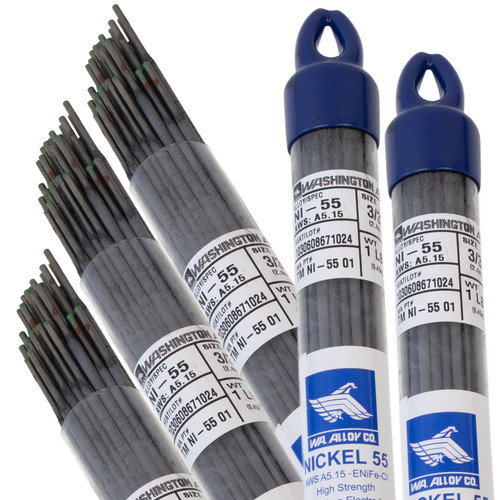
Ni-55 - Nickel Stick Welding Rod (ENiFe-CI), 1 lb. Pack
Starting at
$30.99 - $37.99

Ni-99 - Nickel Stick Welding Rod (ENi-CI), 1 lb. Pack
Starting at
$53.99 - $54.99
Have a question? Ask our team
 (0) Reviews
There are no reviews associated with this product.
Write a Review