


Tensileweld Electrode – 1 lb Pack (Select Size From Options Above)
High-strength AC/DC welding electrode for difficult steels, dissimilar metals, and demanding repair applications.
Washington Alloy Tensileweld is a special-purpose electrode designed for applications where high strength, ductility, and porosity-free weld deposits are important. It is especially useful for welding dissimilar steels, high-carbon steels, tool and die steels, stainless steels, spring and coil steels, pressure vessel steels, aircraft steels, and applications where the exact alloy content of the base metal is unknown.
The weld deposit offers resistance to impact, abrasion, heat, and corrosion while maintaining a smooth, ductile, crack-resistant structure.
Package Information: This Arc-Zone listing is sold in 1 lb packs and is available in 3/32" or 1/8" electrode diameter.
Available Sizes
| Electrode Diameter | Typical Amperage | Typical Voltage | Package |
|---|---|---|---|
| 3/32" | 65–100A | 20–27V | 1 lb Pack |
| 1/8" | 75–135A | 21–28V | 1 lb Pack |
Select either 3/32" or 1/8" electrode diameter from the options above.
Why Choose Tensileweld?
- High-Strength Deposit: Designed for demanding repair and joining applications.
- Porosity-Free Welding: Formulated to produce dense, dependable weld deposits.
- Dissimilar Steel Welding: Useful when joining different steel alloys.
- Unknown Base Metals: A strong choice when the exact alloy content of the base metal is not known.
- Impact Resistant: Helps withstand shock and demanding service conditions.
- Abrasion Resistant: Suitable for components exposed to wear.
- Heat & Corrosion Resistant: Weld deposits provide resistance to elevated-temperature and corrosive service.
- High Deposition Rate: Helps improve productivity on repair and build-up work.
Common Applications
Washington Alloy identifies Tensileweld for a wide range of difficult welding applications, including:
- Dissimilar steels
- High-carbon steels
- Tool steels
- Die steels
- Stainless steels
- Spring and coil steels
- Pressure vessel steels
- Aircraft steels
- Cast steel parts
- Unknown steel alloys
Typical Repair Applications
- Underlay beneath hardfacing alloys
- Mining equipment repair
- Rebuilding shafts
- Agitator blades
- Turbine components
- Framed steel parts
- Cast steel repairs
- Gears
- Tool and die repair
Weld Deposit Characteristics
- High deposition rate
- Smooth weld appearance
- Ductile weld metal
- Porosity-free deposit
- Shiny finished appearance
- Impact resistant
- Abrasion resistant
- Heat resistant
- Corrosion resistant
Typical Mechanical Properties
| Property | Typical Range |
|---|---|
| Elongation | 27–30% |
| Yield Strength | 87,000–95,000 psi |
| Tensile Strength | 95,000–122,000 psi |
Typical Chemistry
| Element | Typical / Specified Range |
|---|---|
| Carbon | 0.25% |
| Silicon | 3.50% |
| Sulfur | 0.03% |
| Chromium | 25.0–33.0% |
| Copper | 1.25% |
| Manganese | 1.0–3.5% |
| Phosphorus | 0.03% |
| Molybdenum | 2.50% |
| Nickel | 8.0–18.5% |
Recommended Welding Practices
Clean the work area before welding and bevel thick sections as required. Washington Alloy recommends a preheat of approximately 400°F for carbon and cast steels where appropriate.
- Use AC or DC reverse polarity (DC+).
- Maintain a short arc.
- Hold the electrode slightly inclined in the direction of travel.
- Use stringer beads.
- Peening is recommended for appropriate applications.
Note: The listed amperage and voltage ranges are typical flat-position parameters. Actual welding settings may vary with position, base material, joint design, equipment, and welding procedure.
Choosing Between 3/32" & 1/8"
| Electrode Size | Typical Amperage | General Selection Consideration |
|---|---|---|
| 3/32" | 65–100A | Good for smaller sections, lower heat input, and applications requiring greater control. |
| 1/8" | 75–135A | Better suited for heavier sections and applications requiring greater deposition. |
Frequently Asked Questions
What is Tensileweld used for?
Tensileweld is designed for high-strength repair and joining applications involving dissimilar steels, high-carbon steels, tool and die steels, stainless steels, spring steels, pressure vessel steels, aircraft steels, and unknown steel alloys.
Can I use it when I don't know what type of steel I have?
Yes. Washington Alloy specifically identifies Tensileweld as useful where the alloy content of the base metal is unknown.
What sizes does Arc-Zone offer?
This listing is available in 3/32" and 1/8" electrode diameters.
How is this product sold?
This Arc-Zone listing is sold in 1 lb packs.
What polarity should I use?
Washington Alloy recommends AC or DC reverse polarity (DCEP / DC+).
What amperage should I use?
The manufacturer lists approximately 65–100 amps for 3/32" electrodes and 75–135 amps for 1/8" electrodes in the flat position.
Can Tensileweld be used before hardfacing?
Yes. Washington Alloy identifies underlaying hardfacing alloys as one of its typical applications.
Is preheating required?
Washington Alloy recommends approximately 400°F preheat for carbon and cast steels where appropriate. The actual requirement depends on the base metal and welding procedure.
Does Tensileweld resist abrasion and impact?
Yes. The manufacturer describes the weld deposit as resistant to impact, abrasion, heat, and corrosion.
-
Welding Process
SMAW / Stick Welding -
Material Type
Chromium & Nickel -
Package Weight
1 lb
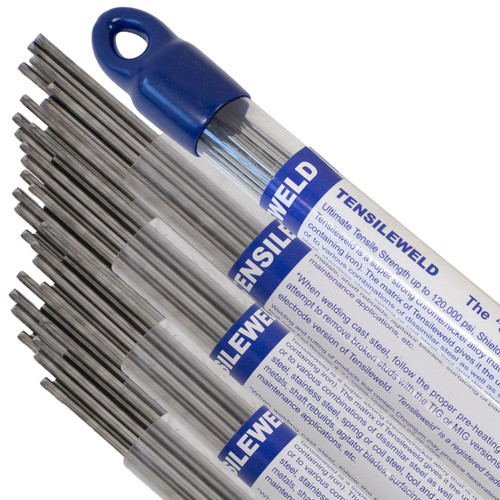
Tensileweld High-Strength Welding Rod – 1 lb. Pack
Starting at
$33.99 - $34.99
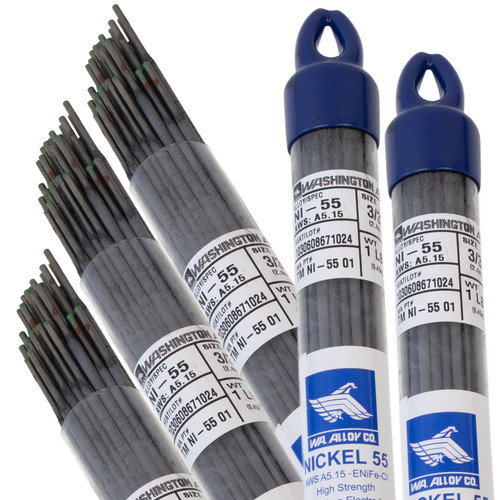
Ni-55 - Nickel Stick Welding Rod (ENiFe-CI), 1 lb. Pack
Starting at
$30.99 - $37.99

Ni-99 - Nickel Stick Welding Rod (ENi-CI), 1 lb. Pack
Starting at
$53.99 - $54.99
Have a question? Ask our team
 (0) Reviews
There are no reviews associated with this product.
Write a Review


